.png)
Know yourself. Free yourself. Be yourself.

Plato's Cave
A Sacred Mirror for Awakening
— As Interpreted through Her Sacred Journey —
“The truth is not for those who wish to remain comfortable.
It is for those who dare to turn toward the light,
even when it burns.”
The Allegory: Shadows on the Wall
Plato’s Cave, written over 2,400 years ago in The Republic, is one of the most enduring metaphors for the spiritual journey.
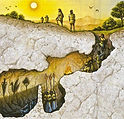
In this allegory, Plato describes a group of people who have been chained inside a dark cave since birth. They are unable to turn their heads and can only see the wall in front of them. Behind them, a fire burns, and between the fire and the prisoners, figures pass — casting moving shadows on the cave wall.
To the prisoners, these shadows are reality. They have never seen anything else.
Then one prisoner breaks free. At first, he is blinded by the firelight. Then, trembling and uncertain, he ascends out of the cave — into the overwhelming brilliance of the sun. There, he sees reality as it truly is — not the flickering illusions on a wall, but trees, stars, the vastness of sky and earth.
When he returns to the cave to share what he’s seen, the others ridicule him. They cannot fathom anything beyond the shadows. His truth threatens their certainty. They reject him. And some versions suggest they might even kill him.
The Meaning: The Journey from Illusion to Truth
Plato’s Cave is the human condition. It is the descent into form — where we mistake societal programming, cultural dogma, and inherited beliefs for reality.
The shadows are the illusions we’ve been taught:
That worth comes from approval
That success is external
That those who die with the most toys win
That we are separate from one another
That power lies outside of us
The prisoner who escapes is the soul awakening.
The ascent out of the cave is the path of the mystic, the individuated woman, the wild truth-teller who turns from illusion and seeks the Real.
But awakening is not easy. The light is painful. The climb is steep. And returning to the cave — to share your vision — often invites ridicule, loneliness, and misunderstanding.
This is the cost of truth. And it is the beginning of freedom.
Her Sacred Journey: Living the Allegory
At Her Sacred Journey, we recognize this allegory as not just philosophy — but lived experience. Every person who steps onto the path of awakening is, in some way, leaving the cave.
They begin to question the voices in their head. They start to see that their pain is not punishment, but portal. They become disillusioned with surface-level spirituality and seeks the deeper current beneath it all.
And when they try to share what they're learning — The family may not understand. The friends may judge. The world may say, “Who do you think you are?” But in truth —they are becoming who they truly is.
Her Sacred Journey is a sanctuary for these individuals. We are not here to live in shadows. We are here to remember the sun — and bring its warmth to others who are ready.
Here, we walk the alchemical path:
From calcination to illumination
From false self to soul essence
From fear to embodied love
We honor that awakening is not a trend — it is a transformation. A descent, a death, a rebirth. Just like the one who returned to the cave, our work is not to force others to see — but to stand in the light, unwavering. To live as a lighthouse, not a savior.
An Invitation
If you have begun to see beyond the shadows — welcome. You are not alone. You are not wrong for seeing more. You are not crazy for wanting truth, even when it costs you comfort.
Your journey out of the cave is your offering to the world. And even if there are some who cannot yet see — You are seen. There are those who know this terrain. And as we find one another, we walk together.
“Those who are able to see beyond the shadows and lies of their culture will never be understood by the masses.”
— Plato
